
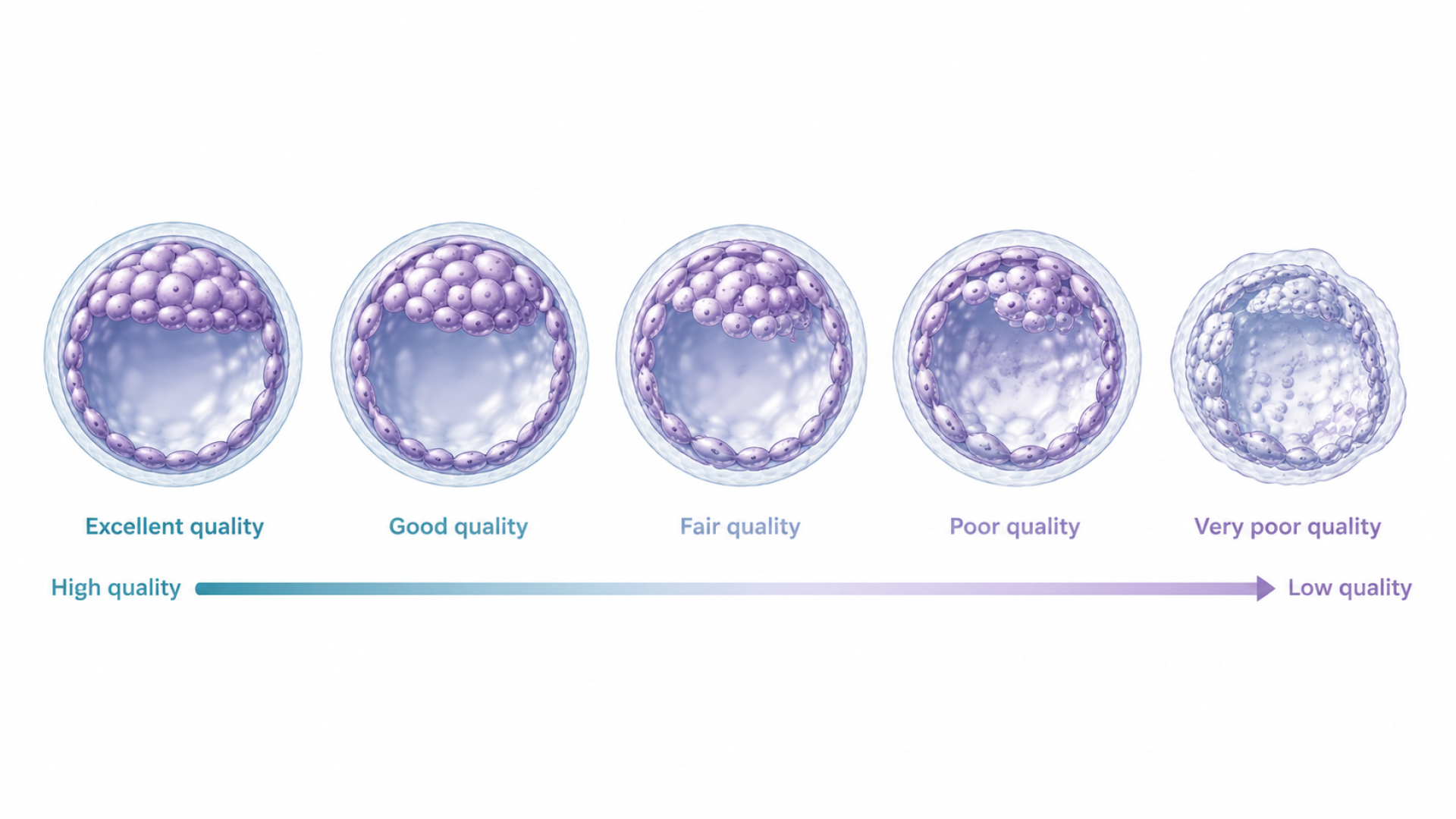
What Is Embryo Quality?
Embryo quality refers to the developmental characteristics used to evaluate embryos during assisted reproductive treatments such as in vitro fertilization (IVF).
Embryologists assess embryo morphology and developmental progression to estimate implantation potential and reproductive competence.
Embryo quality is an important factor in embryo selection during IVF treatment.
How Is Embryo Quality Evaluated?
Embryo assessment is typically based on:
- cell number
- symmetry
- fragmentation
- developmental timing
- blastocyst formation
- cellular organization
Evaluation criteria vary according to the embryo developmental stage.
Cleavage-Stage Embryo Assessment
Early embryos are commonly evaluated around day 2 or day 3 after fertilization.
Embryologists analyze:
- number of blastomeres
- cellular symmetry
- fragmentation patterns
- developmental progression
Appropriate cleavage patterns are generally associated with better developmental competence.
Blastocyst Assessment
Blastocyst evaluation typically occurs around day 5 or day 6.
Assessment includes:
- blastocyst expansion
- inner cell mass quality
- trophectoderm appearance
Blastocyst-stage embryos may provide additional information regarding developmental potential.
Does Embryo Quality Predict Pregnancy?
Higher-quality embryos are generally associated with:
- improved implantation rates
- increased pregnancy probability
- better developmental competence
However, embryo morphology alone cannot fully predict reproductive outcomes.
Successful implantation also depends on:
- endometrial receptivity
- chromosomal status
- molecular signaling
- immune interactions
Embryo Quality and Genetics
An embryo may appear morphologically normal while still carrying chromosomal abnormalities.
For this reason, some IVF treatments incorporate:
- preimplantation genetic testing (PGT)
- time-lapse embryo monitoring
- advanced embryo selection technologies
These approaches aim to improve embryo selection and treatment outcomes.
Factors Influencing Embryo Quality
Embryo quality may be influenced by:
- maternal age
- sperm quality
- ovarian reserve
- laboratory conditions
- culture systems
- genetic factors
Lifestyle and environmental influences may also affect reproductive biology.
Embryo Quality in Modern IVF
Modern embryology laboratories use highly controlled environments to optimize embryo development.
Technological advances include:
- time-lapse incubators
- AI-assisted embryo assessment
- personalized embryo transfer
- non-invasive embryo analysis
Research continues to improve understanding of embryo viability and implantation biology.
Clinical Relevance
Embryo quality assessment is central to reproductive medicine and IVF decision-making.
It supports:
- embryo selection
- treatment planning
- single embryo transfer strategies
- personalized fertility care
Understanding embryo quality helps improve reproductive outcomes while minimizing treatment risks.
